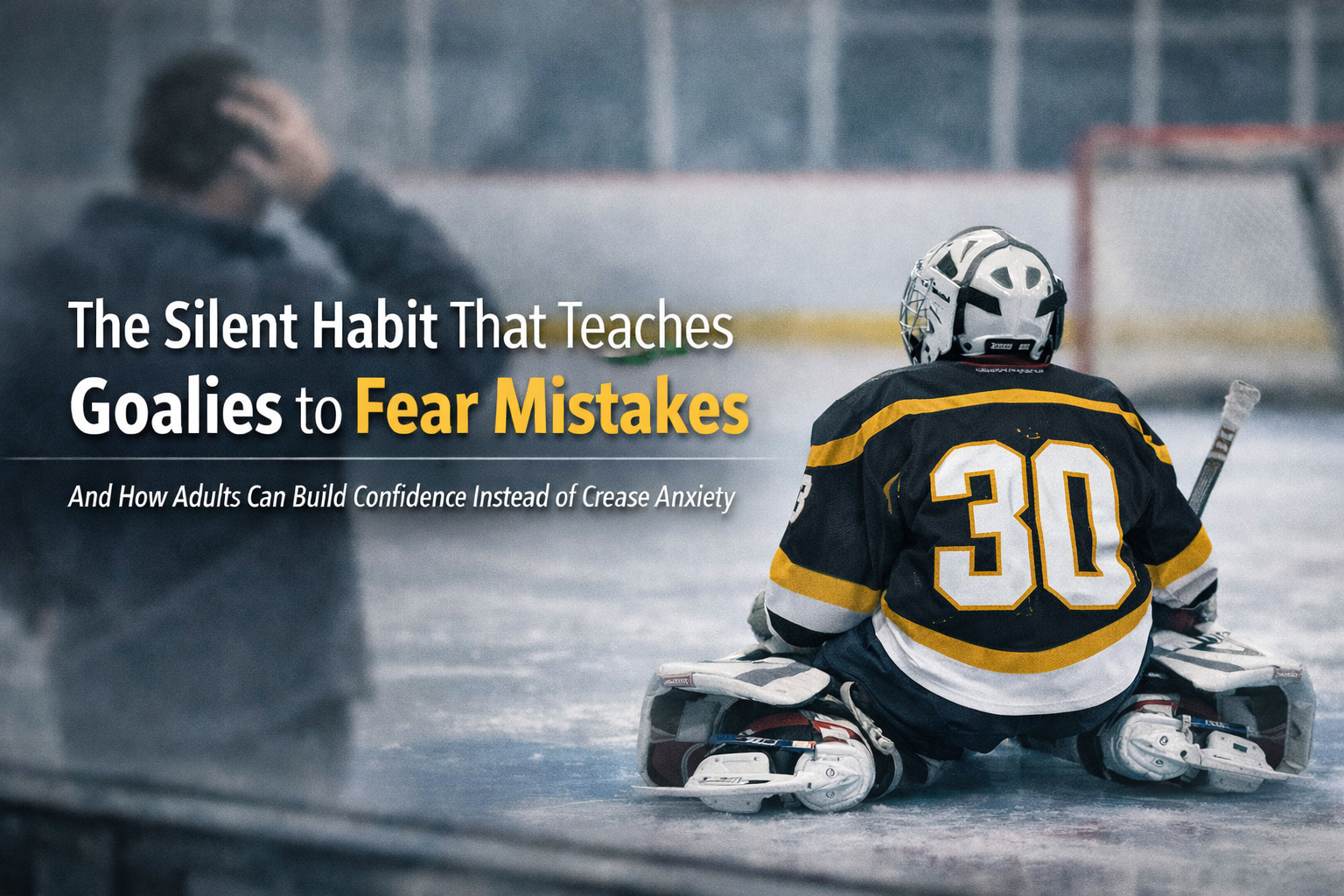
How Can Adults Build Confidence Instead of Crease Anxiety
Most young goalies are not naturally afraid of making mistakes.
Watch a young goalie learning a new movement:
They miss a push.
They lose an edge.
They recover and try again.
No hesitation.
No self-judgment.
No fear.
Fear isn’t something goalies are born with — it’s learned.
Often unintentionally, from the adults behind the glass.
Where Goalie Fear Begins
There is one common adult behaviour that quietly creates mistake-anxiety in goalies:
Immediate correction.
Every time a goalie makes a mistake, an adult reacts.
A sigh.
A head shake.
Hands on hips.
A look of disappointment from behind the glass.
Sometimes a corrective body movement comes first —
followed by words like:
“Stay deeper.”
“Don’t challenge there.”
“Why did you push like that?”
The reaction often comes before the goalie has time to self-correct or take feedback from the coaches on the ice.
It happens instantly —
before the goalie can feel the play, read the situation, or process the rep.
Although it comes from good intentions, this pattern teaches the wrong lesson:
- Mistakes are dangerous
- Mistakes create tension
- Mistakes trigger adult reactions
- Mistakes should be avoided
Over time, this reshapes how a goalie plays the position.
How Mistake Anxiety Shows Up in Goalies
Once the pattern sets in, the signs become clear:
- Less assertive depth
- Less movement confidence
- Less trust in reads
- More hesitation
- More cautious play
- Constant glances to the bench or parents for reassurance
Their game becomes smaller.
Safer.
Predictable.
Instead of trusting their reads, they sit back.
Instead of challenging space, they play deep.
They hesitate on pushes, second-guess rotations, and wait instead of reacting.
The issue isn’t skill —
it’s confidence, and when confidence wavers, performance follows.
What High-Growth Goalies Do With Their Learning
Goalies who develop fastest aren’t the ones trying to avoid mistakes.
They’re the ones who apply what they’ve learned and allow the game to test it.
On the ice, this shows up as:
- Trying different reads based on what they’ve practiced, not freezing when the play changes
- Exploring movement solutions instead of forcing a single response
- Recovering quickly after goals by resetting to their habits and cues
- Staying present and focused on execution, not emotion or outcome
These goalies aren’t reacting to outside feedback in the moment.
They’re trusting the learning they’ve already done.
Their focus stays on the next shot, using the reps, habits, and concepts they’ve trained — not on correcting the last execution.
That freedom to apply learning in real time is what allows instinct, timing, and athleticism to show up naturally during play.
What Goalies Actually Need
Instead of instant correction, goalies need:
- Space
- Time to process the play
- Time to adjust movement
- Time to problem-solve on their own
When goalies work through mistakes themselves, they develop:
- Stronger read-and-react skills
- Better decision-making under pressure
- Higher resilience after goals
- True understanding instead of memorized instructions
This is how goalies become adaptive, confident, and composed in the crease.
The Shift Adults Can Make
Great goalie coaching — and great goalie parenting —
isn’t about correcting every rep.
It’s about supporting the learning process.
When adults step back — even for a few seconds — and allow the goalie to process the moment, confidence rises fast.
The goalie learns:
“I can solve this.”
“I’m allowed to make mistakes.”
“Mistakes help me get better.”
That mindset is what unlocks calm, controlled, game-ready performance.
FINAL THOUGHT
If we want goalies who are confident, composed, and creative under pressure,
we must give them room to learn — not reasons to play scared.
Mistake freedom builds growth.
Mistake anxiety builds hesitation.
In the crease, and behind the glass,
the choice — and the impact — is ours.
HERE’S A LEARNING RESOURCE TO BE BETTER PREPARED
If you want your goalie to be better prepared and train with purpose, the Goalie Toolbox breaks them down with detailed videos, coaching cues, and at-home resources to help every practice count.
‘Long Spine Hip Hinge Into Butterfly Loaded Hands’ Isolation Drill
At Home – Isolation Drill
PRACTICE OVERVIEW
Series: Down Low Transitions
Technical Skill: Butterfly Stance
This isolation drill refines body positioning, balance, and reaction efficiency. By reinforcing core engagement and proper posture, goalies develop quicker hand movements and controlled responses. Regular repetition builds muscle memory for fluid, game-ready transitions, enhancing coordination and reaction on the ice.
Not a Goalie Toolbox member yet?
Unlock elite goalie training tools and resources today with these special offers.
FREE 1-Year Goalie Toolbox Membership
($197 value) when you register for any Cycle Clinic or Camp at one of our locations.
Training From Home?
Can’t attend in person?
Sign up for a Goalie Toolbox Online Membership and get 50% OFF using promo code:
GTBYEAR1
Send me an email at [email protected] with any questions about our programs!
ScotiaBank: 905-860-1111 ext 2